

Both carry a petrol engine, an electric motor and a battery, but they suit very different drivers. The hybrid vs plug in hybrid choice comes down to one habit: will you plug the car in almost every night? A regular hybrid charges itself, costs less and saves fuel for everyone, especially in town. A plug-in hybrid carries a battery big enough for 30 to 50 miles on electricity, which can make most daily trips almost petrol-free, but it costs thousands more and only pays off if you charge it. Skip the charging and real-world studies show it burns far more fuel than its label suggests. Here is how to tell which one fits.
Table of Contents
Hybrid and Plug-in Hybrid at a Glance
Dealers shorten the question to PHEV vs HEV. Here is what separates the two on the things buyers pay for, using the 2026 Toyota RAV4, which is sold as both, as the example.
| Hybrid (HEV) | Plug-in hybrid (PHEV) | |
|---|---|---|
| How it charges | Itself, from the engine and braking | From a plug, plus the engine and braking |
| Electric-only driving | A mile or so at low speed | About 30 to 50 miles on most current models |
| Battery size | Small, typically 1 to 2 kWh | Large, often 15 to 25 kWh |
| 2026 RAV4 starting price | $31,900 (LE FWD, before destination) | $42,950 (SE AWD, with destination) |
| Fuel use if never charged | Low | Similar to or worse than the hybrid, because it carries a heavier battery |
| Best for | Almost everyone, especially town driving | Drivers who can charge at home every night and do short daily trips |
How Hybrids and Plug-ins Actually Differ
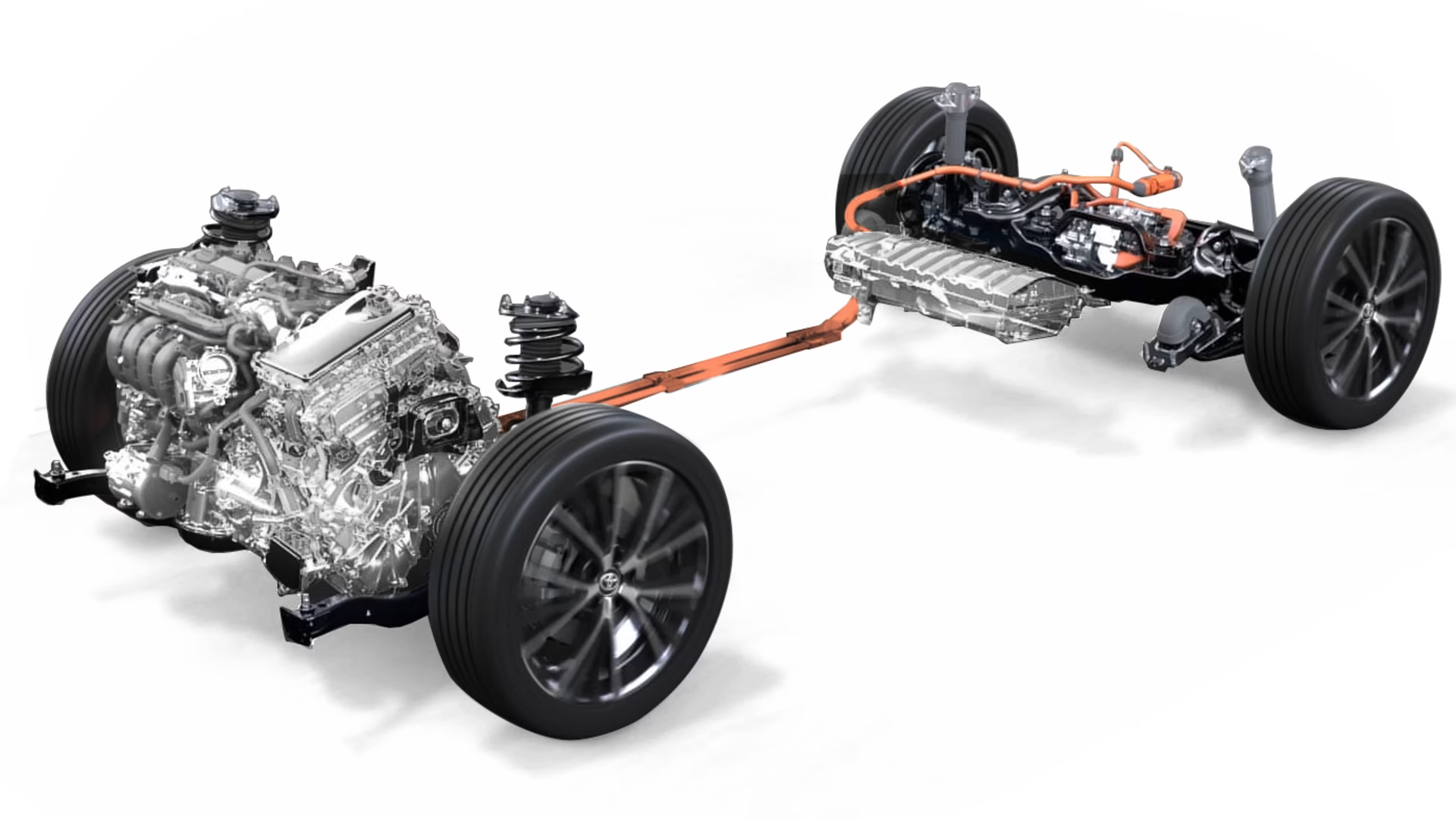
The hardware looks similar on a diagram. The difference is the size of the battery and where its energy comes from, and that decides how the car behaves day to day. There is also a third, simpler kind that often gets sold under the same word.
The Full Hybrid (HEV)
A full hybrid, such as a Prius, Corolla Hybrid or RAV4 Hybrid, has no plug. The battery fills up from the engine and from regenerative braking, which turns the car’s momentum back into electricity instead of heat in the brake pads. The electric motor moves the car at low speeds and helps the engine when you accelerate, so the engine runs less and in its most efficient range. As fueleconomy.gov puts it, these cars are fuelled with petrol only, yet they can be very efficient. The gain is biggest in stop-start traffic, where an ordinary car wastes the most fuel.
The Plug-in Hybrid (PHEV)
A plug-in hybrid adds a much bigger battery and a charging port. Charged from the mains, it drives as an electric car until the battery runs down, then carries on as a normal hybrid. The new RAV4 Plug-in Hybrid, for example, is rated for up to 52 miles on electricity by Toyota, against 42 miles for the outgoing model. Most plug-ins mix both power sources at higher speeds, so even in electric mode the engine can start on a hard climb or a fast overtake. Some, called extended-range electric vehicles, use the engine only as a generator and never drive the wheels with it.
The Mild Hybrid: Hybrid in Name Only
A mild hybrid uses a small electric motor, usually on a 48-volt system, to help the engine pull away, run the stop-start system smoothly and recover a little braking energy. It cannot drive the car on electricity alone, and its fuel saving is small. Many European models carry a hybrid badge on this basis. If a car can’t creep through a car park silently with the engine off, it is a mild hybrid, not a full one, and you shouldn’t pay full-hybrid money for it.
What You Pay to Buy and Run Each
The plug-in always costs more up front. Whether it earns that back depends on fuel and electricity prices and, above all, on how many of your miles it covers on the plug.
The Purchase Premium
On the 2026 RAV4, the AWD SE Hybrid costs about $5,400 less than the AWD SE Plug-in Hybrid, which in turn has 324 hp against 236 hp. That gap is typical of plug-ins across the market. Toyota has also made the standard RAV4 hybrid-only for 2026, so on many popular models the hybrid is no longer an extra-cost option at all, which settles the hybrid half of the question by default.
The Federal Tax Credit Is Gone
Until recently a qualifying plug-in hybrid could earn a federal tax credit of up to $7,500, which often wiped out the price gap. That credit ended for vehicles acquired after September 30, 2025, so in 2026 the plug-in has to justify its premium on running costs alone. Some states and electric utilities still offer their own rebates, so check locally before you buy.
How Much Fuel Each Saves
fueleconomy.gov estimates that plug-in hybrids use roughly 30% to 60% less petroleum than conventional cars, depending on how far they go on electricity. A full hybrid’s saving is smaller but needs no effort: the 2025 RAV4 Hybrid was rated at 39 mpg combined, against about 30 mpg for the petrol-only version. At the late-October 2026 US average of $4.27 a gallon, that difference is worth roughly $400 a year over 12,000 miles. Home electricity is usually cheaper per mile than petrol, so a plug-in that does most of its miles on the battery saves more again, but only if it is charged.
The Catch: Plug-ins Only Work If You Plug In
A plug-in’s official rating assumes a certain share of electric driving. Real owners don’t always manage it. A 2022 ICCT study of US plug-in hybrids found real-world fuel consumption 42% to 67% higher than the EPA label, because drivers charged less often than the label assumes. European data is starker: a Fraunhofer analysis of nearly a million plug-ins found they burned about three times their official figure, with private owners driving on electricity only around 45% to 49% of the time and company-car drivers far less.
The reason is simple. Once the battery is flat, a plug-in hybrid is a regular hybrid hauling several hundred pounds of extra battery. If you can’t charge at home or work, or you mainly drive long highway trips, a regular hybrid will usually use less fuel and cost less to buy.
Charging a Plug-in Hybrid at Home

You don’t need a public charger. Every plug-in comes with a cable for a standard 120-volt outlet, which refills a smaller battery overnight, and a 240-volt Level 2 home charger does it in a few hours. Some new models, including the 2026 RAV4 Plug-in Hybrid in Woodland and XSE trims, add DC fast charging, but that matters little when the battery only covers 50 miles. The real requirement is a parking spot with a socket you can use every night. Renters without one should think hard before paying the plug-in premium.
Reliability, Batteries and Servicing
Full hybrids, Toyota’s above all, have a long record of reliability, and a full hybrid’s brakes often last longer because regeneration does much of the slowing. Plug-ins are more complex, with a charger, bigger battery and more cooling, and survey data reflects it: in Consumer Reports’ 2026 rankings, plug-in hybrids and electric cars made up half of the least reliable models it rated. Battery warranties are long on both types, typically 8 years or 100,000 miles, and 10 years or 150,000 miles on Toyota’s hybrid batteries. Servicing is no more frequent than on a petrol car, though there are a few hybrid-specific checks worth adding to the schedule.
RAV4 Hybrid or RAV4 Plug-in Hybrid?

The RAV4 is the clearest real-world test of the choice, because Toyota builds both on the same body. The 2026 hybrid starts at $31,900 and the plug-in at $42,950 with destination. For the extra money you get roughly 90 more horsepower, standard all-wheel drive and up to 52 miles of electric range, with Toyota estimating 41 mpg combined once the battery is spent.
Buy the plug-in if your daily round trip is under about 40 miles and you can charge at home: most of your driving becomes electric, and the extra performance is a genuine bonus. Buy the hybrid if you can’t charge every night, cover long highway distances, or simply want the lowest total cost. For most buyers the hybrid is the smarter purchase. For a disciplined home charger with a short commute, the plug-in is the better car.
Are Hybrids Worth It?
For most drivers in 2026, a full hybrid is worth it, and on a growing number of models it no longer costs anything extra because the petrol-only version has gone. The savings are largest for town drivers, ride-share and taxi work, and anyone who keeps a car for many years. A plug-in hybrid is worth it for a narrower group: people who can charge at home, drive mostly short distances and will actually plug in. For high-mileage highway drivers, a good diesel or an efficient petrol car can still make sense, and the tradeoffs there are a different calculation.
Hybrids and Plug-ins in Kenya

In Kenya the hybrid question is mostly answered already. Japanese full hybrids, such as the Aqua, the Fielder and Axio hybrids, the Prius and hybrid versions of the RAV4 and Harrier, are among the most common imports, and they thrive in stop-start town traffic. Watch for the Nissan Note e-Power: it drives only on its electric motor, but it cannot be plugged in, because its petrol engine is purely a generator. Plug-in hybrids such as the Prius PHV and Outlander PHEV are rare, partly because few buyers can be sure of charging at home and parts and specialist knowledge are thin.
One advantage Kenyan owners do have is mains power at 240 volts, so a plug-in charges from an ordinary household socket much faster than from a US 120-volt outlet. For most local buyers, though, a well-documented Japanese full hybrid is the safer buy, and checking the hybrid battery with a diagnostic scan before paying matters more than the mileage on the dash. The full hybrids also feature heavily on the list of cars worth buying in Kenya, and the RAV4 and Harrier hybrids among the used SUVs that make the most sense here.
Which Should You Buy?
Choose a full hybrid if you want lower fuel bills without changing how you live, can’t charge at home, or drive long distances. Choose a plug-in hybrid only if you can charge every night, most of your trips fit inside its electric range, and you value the extra performance enough to pay several thousand dollars more now that the tax credit is gone. Avoid paying a premium for a mild hybrid badge, and if you are buying used, check the battery’s health before anything else.

Frequently Asked Questions
What is the difference between PHEV vs HEV?
An HEV, or regular hybrid, charges its small battery from the engine and braking and can’t be plugged in. A PHEV has a much bigger battery you charge from the mains, giving roughly 30 to 50 miles of electric driving before it runs as a normal hybrid.
Are hybrids worth it in 2026?
For most drivers, yes. A full hybrid saves fuel without any change in habits, and on many models, including the 2026 RAV4, it is now the standard engine rather than an extra-cost option.
Is a plug-in hybrid worth it if I can’t charge at home?
Usually not. Without regular charging a plug-in runs as a heavier regular hybrid, and US and European studies show real-world fuel use far above the official figures when owners rarely plug in.
Should I buy the RAV4 Hybrid or the RAV4 Plug-in Hybrid?
Buy the plug-in only if you can charge nightly and your daily driving fits inside its electric range of up to 52 miles. Otherwise the hybrid is the better value: about $5,400 cheaper comparing AWD SE models, and about $11,000 cheaper in base form.
Do plug-in hybrids need more maintenance than hybrids?
Routine servicing is similar, but plug-ins have more parts, including an on-board charger and a larger battery with its own cooling, and reliability surveys rate them below regular hybrids on average.
The Bottom Line
A full hybrid is the default right answer: cheaper to buy, efficient without effort and proven over two decades. A plug-in hybrid is a better car only for drivers who will charge it nearly every day, and it is a worse one for everybody else. Be honest about your parking and your commute before you pay the difference, and check fueleconomy.gov’s plug-in hybrid guide for any specific model’s electric range and costs.